
The best alternative to Tailride in 2026
Tailride collects invoices from mail and portals. Calitem connects document entry with purchases, approvals and posting in the ERP.
Last updated:
Short answer
Choose Calitem to automate business processes with custom workflows, including purchase checks, line-level allocations and your own approval rules. It adapts to the rules of companies and accounting firms and generates journal entries for their ERP.
Consider Tailride if your main problem is gathering invoices scattered across mailboxes and supplier portals. Its proposal combines automatic search, history recovery and accounting export.
What is Tailride and how does it work?
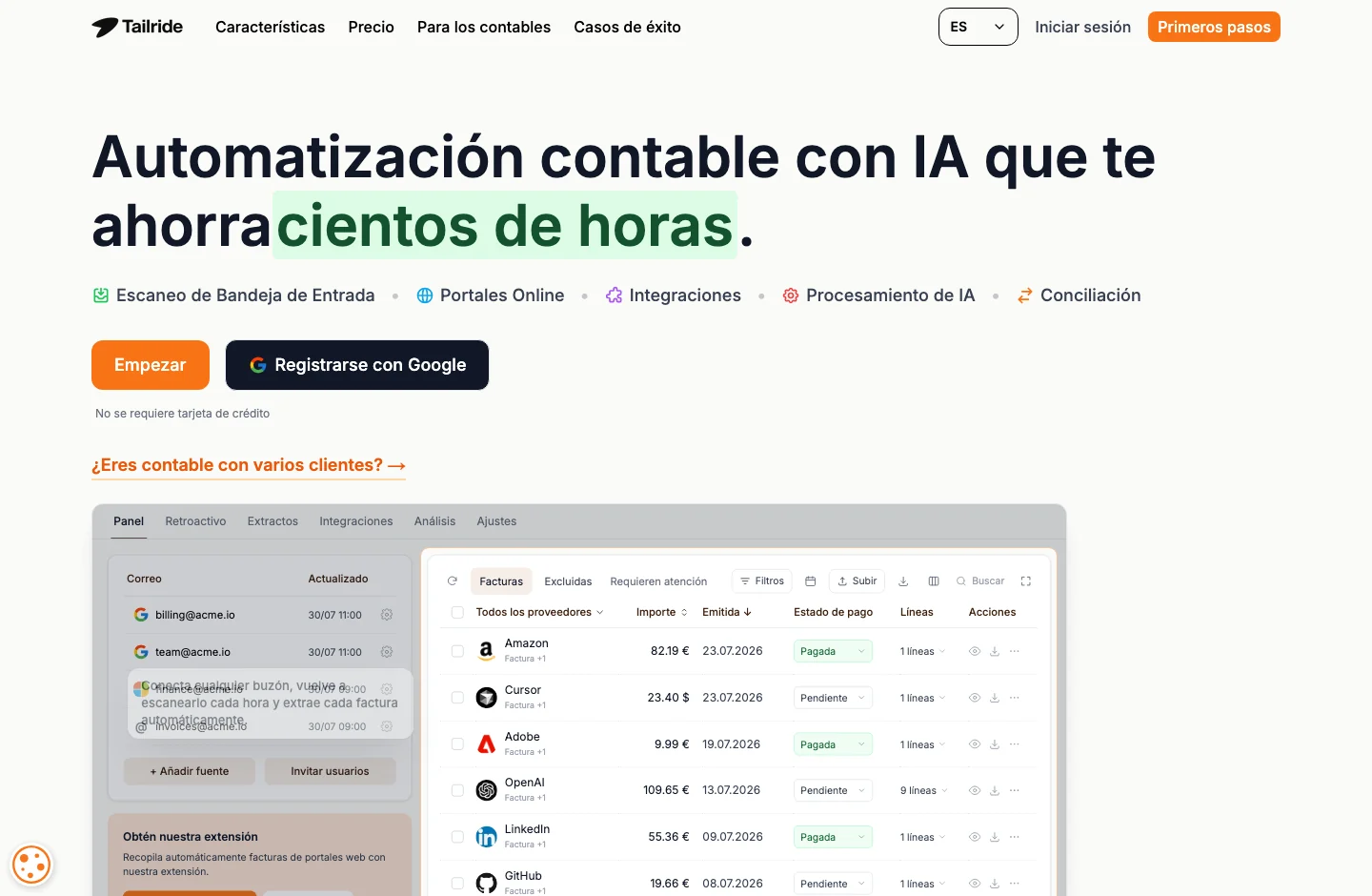
Tailride is an invoice collection and processing tool for businesses and accountants. Connect mailboxes, retrieve documents from portals, and prepare your data to send to accounting programs or repositories.
This is how the work is organized:
- Connect the sources.The team connects their mailboxes and uses the browser extension to retrieve invoices from portals.
- Extract and classify.Tailride extracts fields and lines and applies rules to prepare accounting information.
- Deliver and check.Documents are exported to connected destinations. Cross-checking with extracts helps to locate pending receipts.
Both automate receipt and accounting classification. Tailride focuses its proposal on finding and collecting invoices; Calitem connects the documentation with the purchase verifications, allocations and approvals of the operation.
When Tailride fits
- Invoices distributed between mailboxes.You want to find the invoices that different people receive without asking for each resend.
- History to recover.You need to gather documentation from previous months from the email.
- Shopping on portals.Download invoices from suppliers who publish them on their website.
What is Calitem?
Calitem is the AI accounting system that automates accounts payable, from receiving documents to posting journal entries in your ERP.
It is designed for companies where each invoice can require several checks: finding the purchase order, checking what was received, allocating the expense and obtaining the right approval. Calitem connects this work with your accounting rules and business systems.
Where Tailride has the advantage
Searching connected mailboxes
Tailride connects to email to locate invoices without depending on the forwarding of each message. It fits when documents go to different people and part of the accounting job is chasing down attachments or asking for them to be forwarded.
Recovery of previous invoices
Retroactive scanning allows you to search for documentation from a previous period within the email. It is useful for catching up on pending months or gathering a history that already exists in mailboxes, but is not yet organized for accounting.
Collection from browser session
Your extension retrieves invoices from portals using the user's session. It is relevant when suppliers publish their documents on their websites and the team has to enter each one to download them.
Detection of pending receipts from extracts
Tailride cross-references bank statement movements with the collected documents. This journey helps to identify payments for which proof is missing and guides the search for the team before completing the documentation for the period.
Where Calitem has the advantage
Documents from your team channels
Calitem receives invoices and documents from email, WhatsApp, Teams and shared repositories. A person in a store or warehouse can send a photo without installing another app. The documentation enters the same accounting process, although it arrives through different channels.
Extraction tailored to your documents
The AI extracts general data, lines and specific fields of your operation. Calitem processes up to 250 documents every five minutes, to absorb large volumes without transcribing invoices one by one. Fields with low confidence are reviewed.
Duplicate invoices under control
Calitem detects duplicate documents automatically. When the same invoice arrives through different channels, your team can identify repetition before it turns into more accounting work.
Matching invoices, purchase orders and delivery notes
Calitem matches the three documents line by line and checks references, quantities, prices and taxes. If more units are invoiced than received, or a price changes, it flags the difference for your team to review before posting.
Accounts and cost centers by line
One invoice can include expenses from several stores, departments or projects. Calitem assigns categories, subaccounts and cost centres to each line using your chart of accounts and the team’s previous classifications.
Approvals that follow your rules
Define who must approve based on the amount, legal entity, cost centre or supplier. Calitem routes each document through the appropriate workflow and can automatically approve transactions that meet your limits.
AI-generated accounting entries
Calitem uses your chart of accounts and previous accounting decisions to generate journal entries and send them to your ERP. Allocations are included, so the team does not have to re-enter information that has already been processed.
Integrations that connect the entire operation
Calitem connects the ERP to stock systems, POS and internal tools using native integrations and an open API. Specific connections adapt to the flow and data your operation needs, to reduce manual transfers between systems.
Several companies, well-organized accounting
Calitem supports multiple legal entities and cost centres. Classifications and approval routes follow your operational structure, whether you are a group of companies or an accounting firm managing clients’ accounts.
Analysis of accounting information
Calitem allows you to analyze the accounting and accounts payable information it processes. Your team can use that data to track the operation and understand expenses, as well as complete the work on each invoice.
Learn more: Document receptionInvoice, purchase order and delivery note matchingApproval workflowsAutomated accounting
Choose Tailride if…
- You want to find the invoices that different people receive without asking for each resend.
- You need to gather documentation from previous months from the email.
- Download invoices from suppliers who publish them on their website.
Choose Calitem if…
- You manage a high volume of invoices or processes that require several checks before posting.
- You need to cross invoices, orders and delivery notes by line and detect differences in quantities or prices.
- You distribute the expense of the same invoice between different accounts and cost centers.
- You want to configure approvals by company code, cost center, amount, or supplier.
- You are looking to automate the generation of entries with your chart of accounts and previous classifications.
- You need to connect the ERP with stock systems, POS or other tools in your operation.
Frequently asked questions about Tailride and Calitem
For which company is Tailride best and for which company is Calitem best?
Tailride fits if your main problem is gathering invoices scattered between mailboxes and supplier portals. Its proposal combines automatic search, history recovery and accounting export. Calitem is designed to automate a high volume of documents and accounts payable processes with purchase reconciliation, allocations by line and approvals adapted to the company or accounting firm, up to the entry in the ERP.
What programs does Calitem integrate with?
Calitem integrates with most ERP available on the market, such as A3, Sage, SAP, NetSuite, QuickBooks, Holded and more than 20 others. Available dimensions vary by connector: channels in a3innuva, projects in Sage, and tags in Holded.
How does Calitem manage cost centers?
Calitem uses projects, channels or other dimensions depending on your accounting software. It can assign them automatically using addresses, descriptions, suppliers or products.
How does Calitem match invoices, delivery notes and purchase orders?
Calitem’s document management system matches invoices, purchase orders and delivery notes and compares their products. It checks references, quantities, prices and taxes line by line and flags differences for review.
How does duplicate detection work in Calitem?
Calitem identifies duplicates based on the digital ID of each document and crossing data such as amounts, document number and supplier to flag duplicates to the user.
How does the workflow builder in Calitem work?
In Calitem you can configure routes by company code, cost center, amount or supplier, with automatic approval for operations that comply with your rules.